For global buyers, choosing a China-based AI stuffed animal supplier involves more than comparing prices. The product must feel soft and inviting while its voice, sensors, or interactive features work reliably. A plush toy may look excellent in a catalogue, yet feel stiff or respond slowly in person. Small details matter.
This guide explores how to assess suppliers through practical questions: Can they provide working samples, clear product specifications, and relevant safety documentation? Do they explain materials, minimum order quantities, production timelines, and quality checks in plain language? Buyers should also ask how software updates, language options, and data handling work, rather than relying on broad marketing claims. Ask for evidence. Verify the details.
A factory visit may not be possible, so dated photos, live video calls, and independent inspections can help buyers understand production conditions. Still, no checklist catches every issue. A sample might perform well while a larger batch reveals inconsistent stitching or sound quality. That possibility deserves attention, not panic. Comparing several qualified suppliers, recording agreed requirements, and testing a pre-production sample can reduce avoidable surprises. The sections ahead offer a grounded starting point for finding a supplier that balances product appeal, dependable manufacturing, and clear communication.
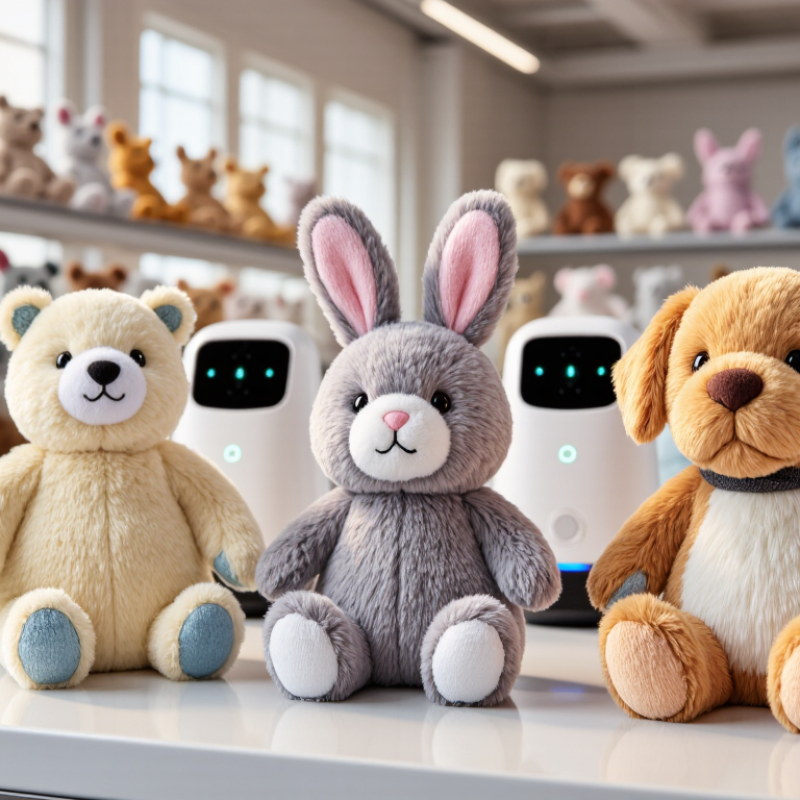
AI plush toys blend soft materials with speech recognition, microphones, speakers, and sensors. A child might ask a question, squeeze a paw, or tilt the toy and hear a response. Touch and motion sensors make interaction feel immediate; voice systems can support conversation, songs, or simple games. Yet “AI” can describe very different functions. Some toys process commands locally, while others need an internet connection for richer replies.
Connectivity affects both play and privacy. Bluetooth SIG’s 2024 Market Update projects annual Bluetooth device shipments will reach 7.6 billion by 2028, across product categories. This signals a broad connected-device ecosystem, not proof that any toy is secure or reliable. Buyers should check connection range, setup steps, microphone controls, and whether the toy still works offline. That matters. A plush friend should not become silent when Wi-Fi drops.
Tips: Test voice pickup in a noisy room, and check whether a child’s quiet question is understood. Ask suppliers where voice data is processed, how long recordings are retained, and how caregivers can disable the microphone. Try the sensors yourself: a gentle squeeze should trigger a clear, consistent response. Keep it simple. Too many features can make play confusing, and even a well-designed toy may misunderstand speech sometimes.
Circana reported a 7% decline in toy sales across 12 markets in 2023. That is useful context for buyers considering AI stuffed animals, but it does not show that every category or country moved in the same way. Nor does it prove that interactive toys caused, or escaped, the wider slowdown. Market figures need careful reading.
For suppliers, the practical question is whether added features solve a real play need. A soft toy with clear, age-appropriate responses may feel more engaging than one that repeats the same phrase. Check response speed, speaker volume, stitching around the module, and how easily the cover can be cleaned. Small details matter. A loud speaker or awkward battery compartment can turn a promising sample into a return.
Ask suppliers for consistent sample testing, clear material specifications, and product documentation suited to the destination market. Compare several production samples, not just one polished prototype. Also test the toy after repeated handling; plush fabric can hide weak seams at first. The sales decline is a caution, not a verdict. Buyers should avoid assuming that “AI” alone will lift demand. That assumption may be wrong. A more grounded choice weighs play value, durability, and price together.
China’s stuffed-animal suppliers often offer OEM, ODM, or a mix of both. With OEM, buyers provide approved designs, dimensions, fabrics, and packaging requirements. The supplier then manages sampling and production. ODM is different: a supplier may develop an original character, select materials, and refine its construction. Buyers should clarify who owns the artwork and whether design changes affect production costs.
AI integration needs the same careful definition. It might mean a voice module, simple interactive responses, or a companion app—not necessarily advanced learning. Ask for a working sample and test it in a quiet room and beside ordinary background noise. Check response time, speaker clarity, charging access, and whether the toy still works when its connection is unavailable. Small details matter.
A practical supplier review includes stitching, fabric feel, battery placement, washable-part limits, and repeat-sample consistency. Request material specifications and written inspection criteria before confirming an order. A prototype can feel excellent yet reveal rough seams after repeated handling. That gap is easy to underestimate. Some features may also add weight, cost, or repair difficulty, so buyers should compare the experience with the added complexity. A clear specification sheet helps both sides catch mismatches early.
Planning guide: The figures below are indicative ranges for supplier discussions, not verified quotes or guarantees. Actual minimum order quantities, lead times, features, and compliance requirements depend on the design, materials, electronics, destination market, and factory.
| Supplier Model | Buyer Provides | Supplier Typically Provides | AI and Technology Options | Indicative MOQ | Indicative Timeline | Best Suited For | Key Checks for Global Buyers |
|---|---|---|---|---|---|---|---|
| OEM — buyer-designed product | Design files or detailed specifications, materials, dimensions, packaging requirements, and branding artwork. | Manufacturing to the buyer’s specifications, material sourcing, sample making, production, and packing. | Can assemble buyer-selected sound modules, sensors, speakers, or connectivity components when agreed in the specification. | Often around 500–1,000 units per design; fabric, color, or component requirements may affect the minimum. | Sample development: roughly 1–3 weeks. Bulk production: roughly 4–8 weeks after sample approval and material confirmation. | Brands with completed designs, established product requirements, and control over intellectual property. | Confirm ownership and permitted use of design files; approve a production sample; check material traceability, workmanship standards, and packaging details. |
| ODM — supplier-developed design | Product brief, target price, intended age group, sales market, preferred features, and requested changes to an existing concept. | Existing or adapted product designs, development support, sampling, manufacturing, and optional packaging customization. | May offer options such as recorded audio, simple interactive responses, lights, or pre-integrated electronic modules, depending on the design. | Often around 300–800 units for adapted designs; customization or special materials can increase the minimum. | Sample or adaptation: roughly 1–3 weeks. Bulk production: roughly 4–8 weeks after approval. | Buyers seeking a faster path to market without developing every plush pattern and component from scratch. | Clarify which design elements are exclusive, whether other buyers can order the base design, and which changes are included in development costs. |
| AI-enabled integration | Product requirements, target markets, intended user experience, language needs, app or cloud requirements, and data-handling expectations. | Plush manufacture plus coordination or integration of electronic components; software, app, and cloud services may be supplied by separate partners. | Potential features include voice input and output, speech recognition, conversational software, sensors, Bluetooth or Wi-Fi connectivity, and companion-app functions. Feature availability varies by design. | Often around 500–1,500 units or more for customized electronic builds; component sourcing and software development can change the minimum. | Prototype and integration: roughly 3–8 weeks or longer. Bulk production: roughly 6–12 weeks after design, software, and testing approval. | Buyers developing connected or interactive plush products who can manage software, support, and post-launch updates. | Identify who owns the software and voice data; review connectivity dependencies, privacy requirements, battery safety, firmware update plans, and support responsibilities. |
| Hybrid OEM/ODM with selected electronics | A custom plush design or an adapted supplier design, plus a defined list of electronic features and performance requirements. | Plush development and production with agreed electronic components assembled or installed as part of the product. | May combine pre-recorded audio or sound effects with buttons, motion sensors, or other limited interactive functions; advanced AI may require a separate software provider. | Often around 500–1,000 units; availability depends on the selected modules and whether they are standard or custom. | Sampling: roughly 2–5 weeks. Bulk production: roughly 5–10 weeks after final approval. | Buyers who want interactive features without commissioning a fully connected AI platform. | Request component specifications and battery details; test the complete finished product, not just the plush shell or electronic module separately. |
| Compliance and export readiness | Destination countries, age grading, sales channels, labeling needs, and any retailer-specific testing requirements. | Depending on the supplier, test coordination, product documentation, export packing, and shipping support may be available. | Electronic products may require additional assessment of batteries, radio functions, electrical components, software, and data practices. | Not applicable; testing and certification costs are usually separate from unit pricing and depend on the product and market. | Allow additional time for testing, corrective changes, documentation, and retesting before launch. | All buyers selling internationally, especially those selling products intended for children. | Confirm applicable rules for each destination. Depending on the market and product, checks may include toy safety, chemical restrictions, radio equipment, battery transport, labeling, and privacy obligations. Verify reports for the exact finished product and model. |
For global buyers comparing AI stuffed animal suppliers in China, safety documentation deserves as much attention as voice quality or stitching. ASTM F963 is a key U.S. toy safety standard, while CPSIA 2008 addresses requirements such as lead limits, applicable third-party testing, and tracking labels. EN 71 covers important toy-safety topics for European markets. ISO 8124 provides an international series of toy-safety standards. Details matter.
Ask suppliers for test reports matching the exact model, fabric, filling, electronics, and age grade—not a similar sample. A plush toy with a sound module or rechargeable battery may need additional assessment beyond basic toy tests. Requirements depend on the destination market and product design, so confirm them with an accredited laboratory or qualified compliance professional. One report is not a passport to every market.
Tips: Request report dates and model numbers. Check that the tested sample includes the final battery compartment, seams, and accessible components. Keep labels and production records consistent. Small differences matter. I have seen teams focus on the cute exterior and overlook a changed fabric supplier; it is an easy mistake, and worth reviewing before shipment.
A supplier’s quoted minimum order quantity is only a starting point. Ask whether the MOQ covers one design, one fabric color, or each voice-enabled configuration. These details change the real cost. Request a sample from the same materials and production process planned for your order. A soft sample can still hide uneven stitching or a loose battery compartment.
Lead times need a clear breakdown. Confirm sample approval, material sourcing, assembly, testing, and shipping separately. Ask what happens if a fabric color is unavailable or a component arrives late. A dated production schedule is more useful than a broad promise. Build in extra time. Timelines can slip.
Quality control should be visible, not just promised. Request written inspection criteria for seams, sound levels, charging, and repeated button use. Ask for inspection photos or reports from a finished batch, and clarify how defects are handled. Test toys after repeated use, not only straight from the box. One overlooked detail can matter.
Data privacy deserves equally specific questions. Find out whether audio is processed on the toy, a phone, or a remote server. Ask what data is collected, how long it is kept, and whether users can delete it. Request a simple data-flow diagram and security documentation. If answers feel vague, pause. I would not treat a friendly sales call as technical proof. Get important commitments in writing.
For global buyers, confirm the requirements of each destination market. The chart shows selected U.S. federal limits relevant to children’s products; it is not a comparison of supplier performance.
Due diligence: CPSIA limits lead in children’s products to 100 ppm, while the U.S. limit for lead in paint and similar surface coatings is 90 ppm. The limit for each of the specified regulated phthalates is 0.1% (1,000 ppm). Check applicability, exemptions, and current rules for your product and destination. Confirm MOQ and lead time in the supplier’s written quote and production schedule. For AI-enabled plush toys, verify testing and inspection plans, and review how children’s voice or other personal data is collected, stored, shared, retained, and deleted.
Sources: U.S. CPSIA, 15 U.S.C. § 1278a; 16 CFR Part 1303; 16 CFR Part 1307. Values are regulatory limits, not supplier test results.
With OEM, buyers provide approved designs, materials, dimensions, and packaging details. The supplier handles sampling and production. With ODM, the supplier helps develop the character and construction. Clarify artwork ownership and design-change costs.
Describe the feature precisely. It could be a voice module, simple responses, or a companion app. Request a working sample and test it in a quiet room and near background noise.
Check the seams, fabric feel, battery placement, and washable parts. Compare repeat samples for consistency. A prototype may feel smooth, then develop rough seams after handling. Easy to miss.
Check response time, speaker clarity, and charging access. Test whether the toy still works without a connection. Listen beside ordinary room noise, not only in silence.
Ask for reports matching the exact model, fabric, filling, electronics, and age grade. A report for a similar sample may not cover the final product. Details matter.
Not necessarily. Requirements depend on the destination and product design. Confirm them with an accredited laboratory or qualified compliance professional. One report is not a passport.
Check report dates and model numbers. Confirm the tested sample has the final battery compartment, seams, and accessible components. Keep labels and production records consistent.
Request material specifications and written inspection criteria before confirming an order. Recheck changes such as a different fabric supplier. I might still miss something; a final review helps.
An AI stuffed animal combines the comfort of a plush toy with features such as voice interaction, sensors, wireless connectivity, and responsive play. These capabilities can help create more engaging experiences, while the reported 7% toy sales decline across 12 markets in 2023 highlights the importance of offering products with clear value and appeal. For global buyers, China suppliers may support different development paths, from OEM production based on a buyer’s specifications to ODM designs and the integration of AI technologies.
Choosing a supplier involves more than comparing prices. Buyers should assess whether products are designed to meet relevant safety benchmarks, including ASTM F963, EN 71, ISO 8124, and CPSIA 2008, and verify how compliance is documented for their target markets. Due diligence should also cover minimum order quantities, production lead times, quality-control procedures, and data-privacy practices for connected features. Clear requirements and regular communication can help buyers manage development and production with greater confidence.