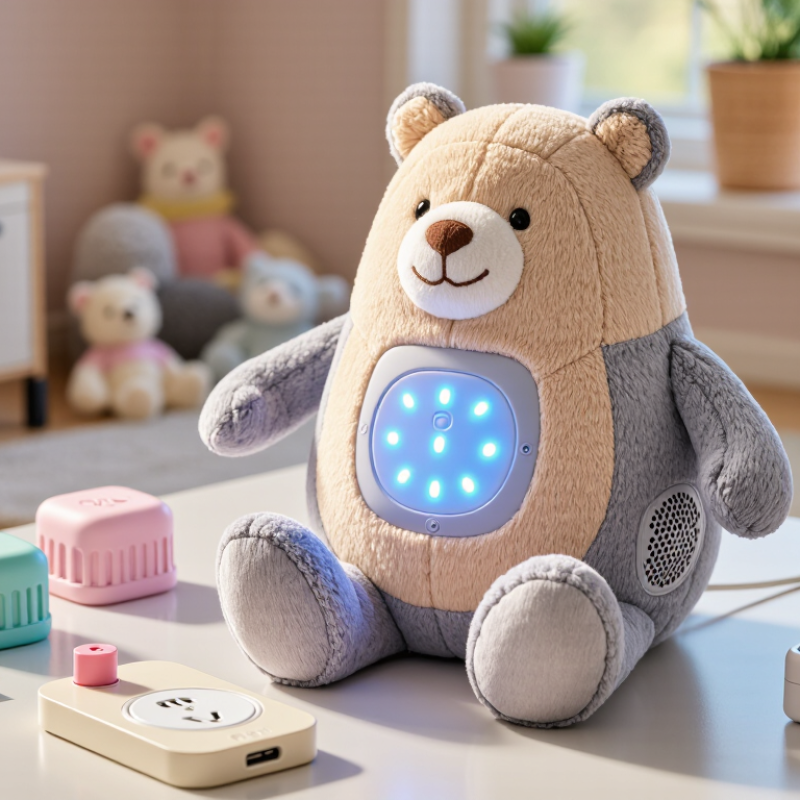
| 0–12 months |
Secure attachment, sensory exploration, visual tracking, grasping, and early cause-and-effect learning. |
Soft textures, gentle lights, low-volume lullabies, and simple caregiver-controlled responses. |
Use securely attached components; avoid detachable small parts, long cords, loose fibers, accessible batteries, and hard projections. Keep sound levels low and surfaces washable. |
Avoid microphones, cameras, location tracking, and internet connectivity unless there is a clear caregiver need. Provide an obvious physical power switch. |
Very high safety priority |
Applicable toy-safety frameworks commonly include ISO 8124, EN 71, and ASTM F963, depending on the destination market. |
| 12–24 months |
Early language, imitation, object permanence, gross-motor movement, and simple problem solving. |
Repeatable words, animal sounds, responsive songs, basic light-and-sound feedback, and parent-selected play modes. |
Design for pulling, squeezing, biting, and dropping. Prevent access to battery compartments and ensure seams, eyes, noses, and electronic modules resist foreseeable use. |
Use offline operation by default. If an app is included, make it parent-facing and avoid collecting child-identifying information. |
Very high safety priority |
Products intended for children under three require particular attention to small-part hazards and foreseeable misuse in many jurisdictions. |
| 2–3 years |
Vocabulary growth, pretend play, emotional recognition, self-regulation, and simple turn-taking. |
Short interactive stories, emotion-themed prompts, limited-choice responses, and predictable routines such as greetings or bedtime sequences. |
Do not include detachable parts that could create a choking hazard. Use rounded edges, durable stitching, secure battery access, and materials suitable for frequent cleaning. |
Provide clear parental controls, no public communication features, and no behavioral advertising. Avoid always-on listening. |
High safety priority |
Check the destination country’s rules for toys, batteries, radio equipment, electrical safety, and children’s data protection. |
| 3–5 years |
Imaginative play, early numeracy, memory, social communication, and understanding of simple rules. |
Interactive storytelling, counting games, memory prompts, multilingual vocabulary, and cooperative parent-child activities. |
Use impact-resistant housings, protected wiring, secure closures, and tested sound output. Clearly separate removable accessories from the plush body. |
Use consent-based setup, minimal data collection, visible microphone indicators, and an easy method to delete recordings or account data. |
High developmental value |
Assess electrical, radio, chemical, flammability, mechanical, and labeling requirements for each intended market. |
| 5–7 years |
Reading readiness, executive function, creativity, rule-based play, and increasingly independent learning. |
Open-ended stories, question-and-answer activities, pronunciation practice, puzzles, timers, and adjustable difficulty levels. |
Explain safe handling of charging cables and accessories. Protect ports, prevent overheating, and maintain stable construction during active play. |
Use a child-safe interface, restricted voice responses, parental dashboards, and strong account security. Disable unnecessary social features. |
High learning priority |
Wireless products may require radio-frequency approvals, while connected products may also need cybersecurity and privacy compliance reviews. |
| 7–9 years |
Independent problem solving, emotional literacy, collaboration, reading comprehension, and creative expression. |
Goal-setting, customizable stories, STEM-themed challenges, language learning, and collaborative offline activities. |
Design for repeated handling, travel, and active play. Use robust charging protection, clear battery warnings, and replaceable or serviceable components where appropriate. |
Explain data practices in child-friendly language. Offer guest mode, parental approval for new features, and data export or deletion controls. |
Balanced safety and usability |
Review children’s privacy requirements, consumer product safety rules, accessibility expectations, and local language-labeling obligations. |
| 9–12 years |
Abstract thinking, self-expression, social awareness, planning, and more complex independent learning. |
Adaptive quizzes, creative audio production, coding concepts, personalized learning paths, and collaborative family games. |
Provide clear instructions for charging, storage, cleaning, and maintenance. Use durable textiles and protect electronics from moisture unless water resistance is specifically tested. |
Minimize profiling, prohibit targeted advertising to children, provide transparent permissions, and make connected functions optional. |
High usability priority |
Consider privacy-by-design principles, age-appropriate design guidance, cybersecurity controls, and market-specific conformity assessment. |
| Family or mixed-age use |
Shared play, communication, inclusion, caregiver participation, and flexible learning across different abilities. |
Multiple user profiles, adjustable volume and speed, multilingual content, offline play, and caregiver-led activity planning. |
Design the product to the youngest intended user’s safety level. Include accessible controls, tactile indicators, clear warnings, and washable or replaceable covers. |
Make the adult the account owner. Use role-based permissions, local processing where feasible, transparent retention periods, and a complete physical disconnect option. |
Broad global-market suitability |
Verify requirements in every target region rather than assuming one global approval covers all markets. |